How Facility Condition Assessments Turn Uncertainty into Strategy
Executive Summary
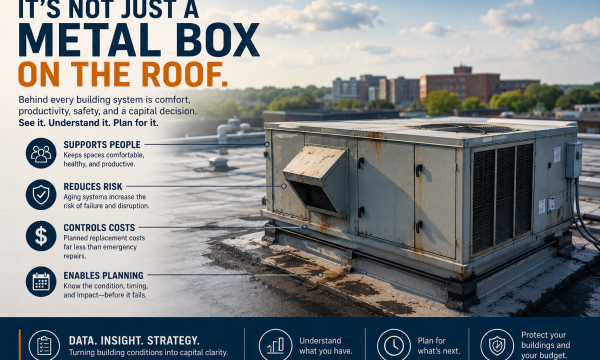
For many organizations, facilities are their largest physical asset—and often their largest source of uncertainty.
Questions arise every budget cycle:
- Why do unexpected capital projects continue to appear?
- Which buildings deserve additional investment?
- Are we spending money in the right places?
- How much deferred maintenance have we accumulated?
- Can we continue to afford our entire portfolio?
- How do we justify capital requests to our board or stakeholders?
Without objective data, these questions are answered with assumptions, anecdotes, or the urgency of the latest emergency.
The result is predictable: reactive spending, growing deferred maintenance, increasing operational risk, and difficult budget conversations.
A Facility Condition Assessment (FCA) changes that.
More importantly, the value of an FCA is not simply the collection of building data—it is the professional interpretation of that data by experienced facilities professionals who understand how buildings perform over decades, how capital projects should be prioritized, and how to transform technical information into practical business strategy.
At AmBIT, we believe that an FCA should never end with a report. It should become the foundation for better decisions, stronger financial stewardship, and long-term organizational success.
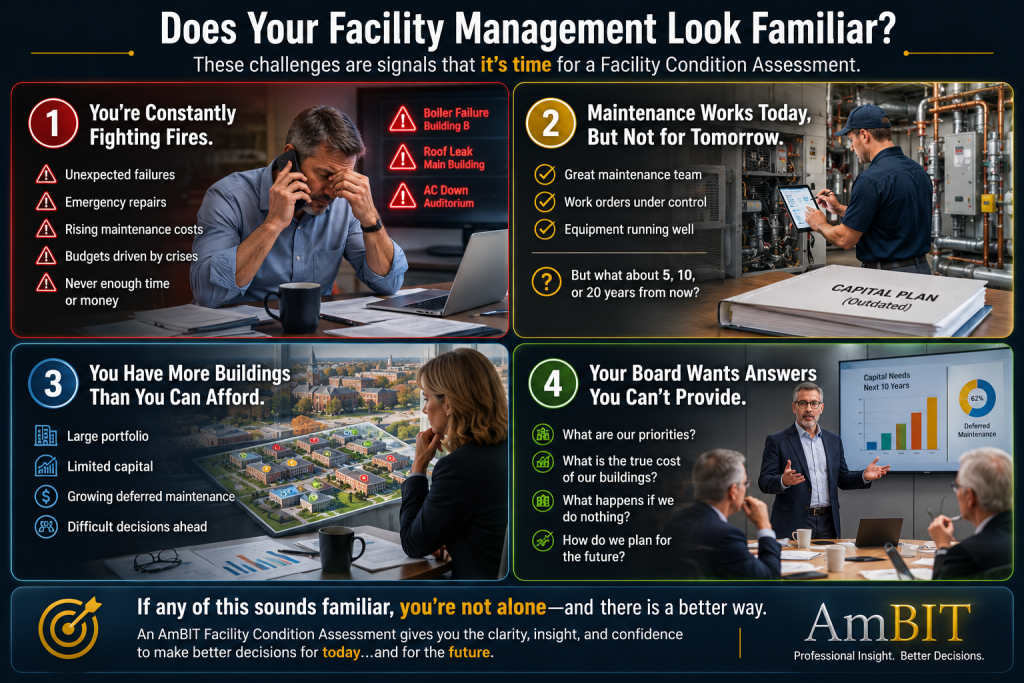
The Warning Signs
Many organizations don’t realize they need an FCA until they’re already reacting to problems.
If any of these situations sound familiar, your facilities may be managing you—instead of the other way around.
Scenario 1:
“We’re Constantly Fighting Fires.”
Every budget meeting feels like another emergency.
A boiler fails.
A roof leaks.
An air conditioning unit quits during the hottest week of the year.
Capital projects are dictated by failures instead of planning.
The organization isn’t necessarily spending too little.
It’s spending without a roadmap.
How AmBIT Helps
Our FCA establishes a comprehensive understanding of every building system, allowing organizations to:
- Understand current facility conditions
- Forecast future capital requirements
- Prioritize projects before failures occur
- Replace emergency spending with planned investment
The result is fewer surprises, lower lifecycle costs, and significantly better control over capital expenditures.
Scenario 2:
“Our Maintenance Program Works… But Only for Today.”
Many organizations have excellent maintenance departments.
Preventive maintenance keeps equipment operating.
Repairs are completed promptly.
Work orders are managed effectively.
Yet one important question often remains unanswered:
What happens five… ten… or twenty years from now?
Maintenance programs are designed to manage operating expenses.
Capital planning requires an entirely different perspective.
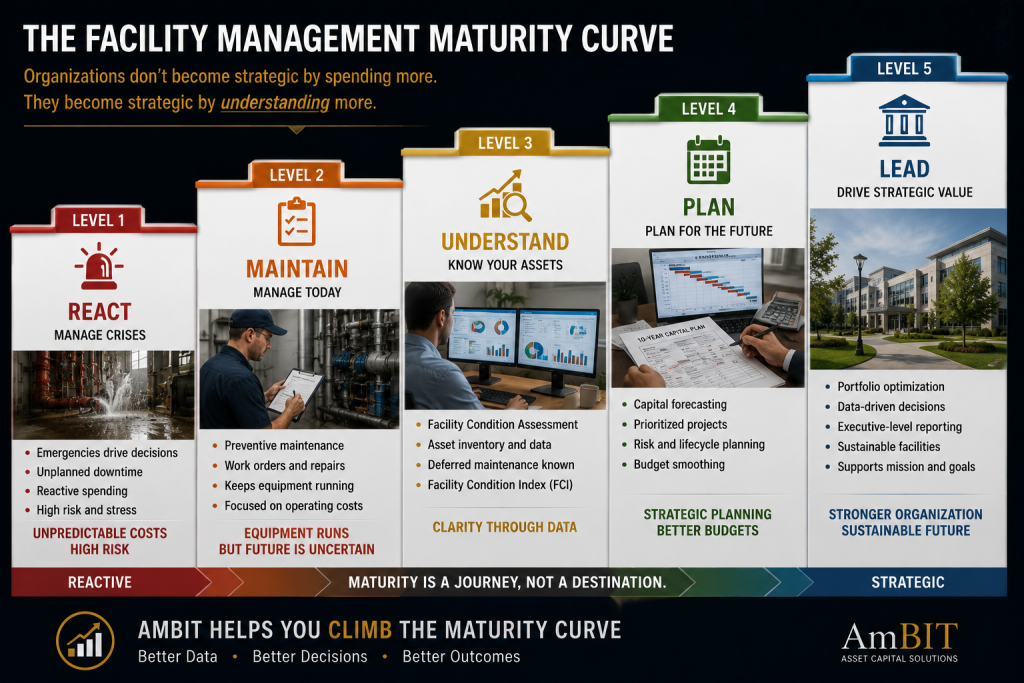
An FCA bridges that gap.
AmBIT Helps Connect Two Worlds
Rather than replacing an existing maintenance program, AmBIT expands it.
We help organizations integrate:
- Preventive maintenance
- Remaining useful life
- Replacement forecasting
- Capital budgeting
- Long-term financial planning
Together, these create a complete asset management strategy.
Scenario 3:
“We Own More Buildings Than We Can Afford.”
This is becoming increasingly common.
Private colleges.
Religious organizations.
Municipalities.
Senior living providers.
Commercial portfolios.
Many organizations simply have more square footage than available capital can adequately support.
Unfortunately, emotional attachment often replaces objective decision-making.
Every building is viewed as equally important.
In reality, they rarely are.
Objective Data Supports Difficult Decisions
An FCA provides measurable information regarding:
- Building condition
- Deferred maintenance
- Capital investment required
- Facility Condition Index (FCI)
- Operational risk
- Replacement cost
Combined with organizational priorities, this information allows leadership to evaluate questions such as:
- Should this building remain in service?
- Should it be renovated?
- Should it be consolidated with another facility?
- Is disposal the most financially responsible option?
These are never easy decisions—but they become much easier when supported by objective data rather than opinion.
Scenario 4:
“Our Board Wants Answers We Can’t Provide.”
Boards, trustees, executives, and financial officers increasingly expect data-driven decisions.
They ask questions such as:
- Why is this project the highest priority?
- What happens if we defer this replacement?
- How much capital should we reserve over the next decade?
- What is our deferred maintenance liability?
Without reliable information, these questions become difficult to answer.
Defensible Decisions
AmBIT transforms technical facility information into executive-level reporting.
Instead of presenting thousands of deficiencies, we help leadership understand:
- Organizational risk
- Funding priorities
- Budget forecasts
- Portfolio trends
- Long-term financial implications
Our goal is to help clients make decisions they can confidently defend to boards, auditors, donors, lenders, and stakeholders.
More Than Data Collection
This is where many FCA providers stop.
They inspect buildings.
They generate reports.
They deliver spreadsheets.
Then they leave.
We believe that’s where the real work begins.
The AmBIT Difference
A successful FCA requires far more than collecting observations.
It requires professionals who understand buildings—not simply inspectors who document them.
Our team brings decades of practical experience in:
- Mechanical systems
- Electrical infrastructure
- Plumbing systems
- Building envelopes
- Capital budgeting
- Facility operations
- Engineering
- Construction
- Asset management
That experience changes the quality of every recommendation.
We don’t simply identify deficiencies.
We help clients understand:
- Which deficiencies truly matter
- Which can safely wait
- Which projects should be combined
- Which investments produce the greatest long-term value
- Which buildings deserve additional investment—and which may not
That professional judgment is what transforms data into strategy.
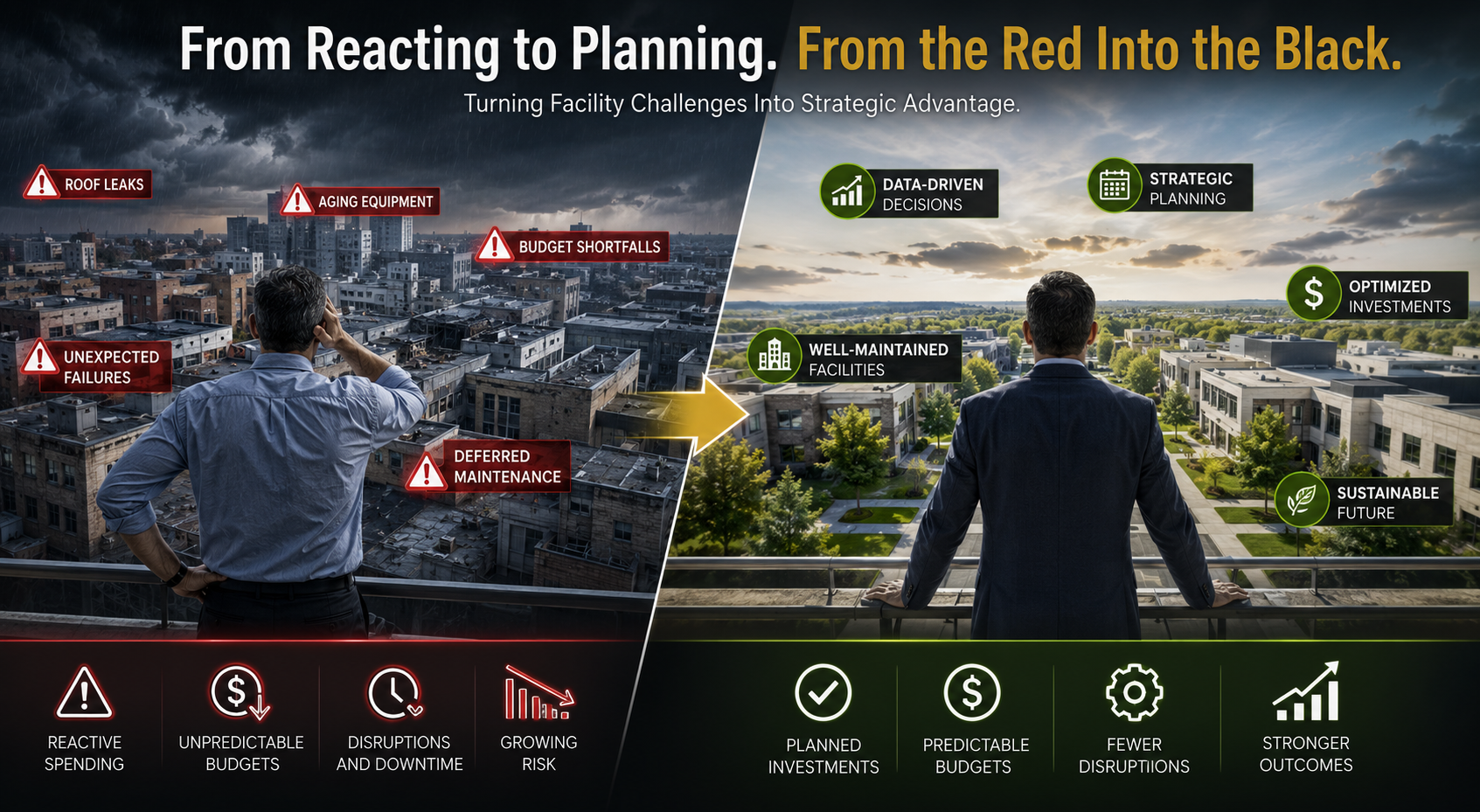
From the Red Into the Black
One of the greatest benefits of an FCA is that it changes the trajectory of an organization’s facilities.
Instead of reacting…
the organization begins planning.
Instead of chasing failures…
it schedules investments.
Instead of unpredictable budgets…
it develops stable capital forecasts.
Instead of managing crises…
leadership manages assets.
The objective isn’t simply to reduce deferred maintenance.
The objective is to create facilities that support the mission of the organization while remaining financially sustainable for decades to come.
The AmBIT Process
Every engagement follows the same progression:
Discover
- Comprehensive Facility Condition Assessment
- Building inventory
- System evaluation
↓
Analyze
- Remaining useful life
- Cost forecasting
- Deferred maintenance
- Facility Condition Index (FCI)
- Risk evaluation
↓
Prioritize
- Operational impact
- Safety
- Mission criticality
- Financial return
- Portfolio optimization
↓
Plan
- Multi-year capital plan
- Budget forecasting
- Project phasing
- Funding strategies
↓
Partner
- Ongoing consulting
- Capital planning updates
- Executive presentations
- Portfolio strategy
- Decision support
Conclusion
A Facility Condition Assessment is not purchased because an organization wants another report.
It is commissioned because leadership needs clarity.
Whether an organization is struggling with deferred maintenance, expanding beyond day-to-day maintenance, managing an oversized portfolio, or preparing for difficult board decisions, the combination of objective facility data and experienced professional guidance provides something far more valuable than a building report:
Confidence.
Confidence to prioritize wisely.
Confidence to invest strategically.
Confidence to make difficult decisions based on facts rather than assumptions.
At AmBIT, that’s our mission.
To transform facility data into informed decisions, sustainable investments, and stronger organizations.

Written by
AmBIT Author