Buildings are full of things that look unimportant — until they stop working.
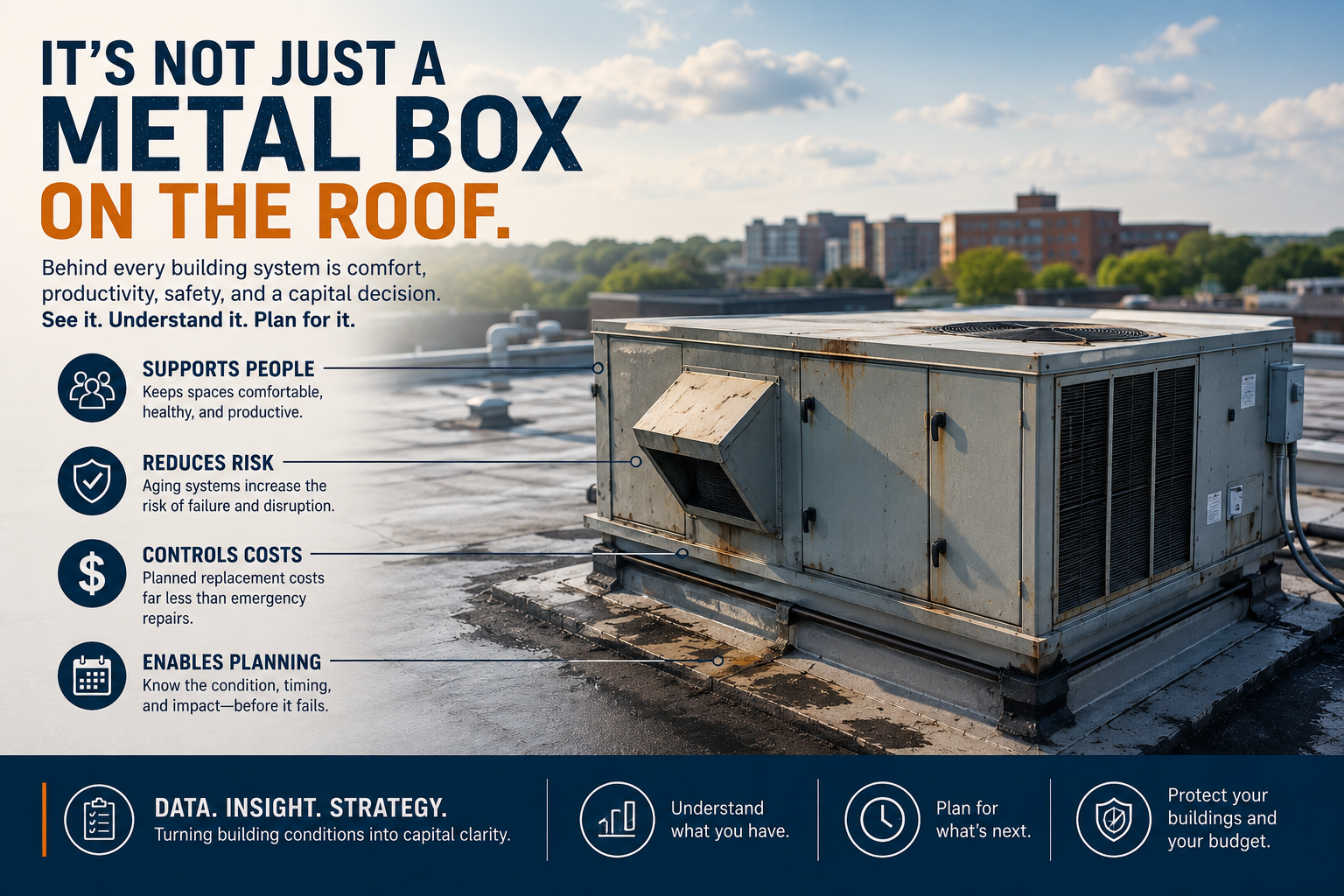
From the parking lot, a rooftop unit looks exactly like what it is: a large metal box sitting on the roof. It is not attractive. It is not exciting. Most people barely notice it.
But that “metal box” may also be what keeps the building comfortable, usable, rentable, operational, and safe. It may support classrooms, offices, conference rooms, kitchens, patient spaces, or tenant suites.
And the moment it stops working, everyone suddenly becomes very interested in it.
That is where capital planning begins.
Not with the equipment itself — but with what the equipment does.
Most People Never Think About Building Systems
Most people do not walk into a building thinking about rooftop units, electrical panels, pumps, controls, or water heaters. They care about outcomes, not infrastructure.
They want:
- Air conditioning when it is hot
- Heat when it is cold
- Lights that turn on
- Water that works
- Spaces that feel comfortable and functional
That is the baseline expectation.
When everything works, nobody notices the building systems making it possible.
That is actually the reward of good facility management.
If systems are functioning properly, people assume the building is fine, the budget is fine, and the metal boxes on the roof are probably fine too.
Facilities teams know better.
Facilities See the Asset Differently
To most occupants, a rooftop unit is invisible.
To Finance, it may simply look like a future expense.
To Facilities, it has a condition, service history, replacement timeline, operational risk profile, and probably a long list of repair notes.
Facilities teams know:
- Which unit struggles during summer
- Which one needs frequent resets
- Which one generates the most complaints
- Which system is technically still running, but only barely
That is not just equipment knowledge.
That is operational intelligence.
The challenge is that operational intelligence often stays trapped inside the facilities department instead of being translated into a capital strategy leadership can evaluate and fund.
Everyone understands the importance of the rooftop unit after it fails.
The real goal is understanding its importance before then.
Finance Does Not Fund “Metal Boxes”
Finance teams have a different responsibility.
They are balancing budgets, reserves, debt, competing priorities, and long-term financial planning. When a capital request arrives labeled “Replace RTU-3,” it may sound technical, expensive, and disconnected from business impact.
So Finance asks questions:
- Why now?
- What happens if we wait?
- Can it be repaired again?
- How much useful life remains?
- Is it mission-critical?
Those are not unreasonable questions.
They are capital planning questions.
The disconnect is not that Facilities and Finance disagree.
The disconnect is that they are often viewing the same asset from completely different perspectives:
- Facilities sees operational risk
- Finance sees financial cost
Both perspectives are correct.
But neither side has the full picture alone.
A Facility Condition Assessment Makes the Invisible Visible
This is where a Facility Condition Assessment (FCA) becomes valuable.
A good FCA is not simply a giant inventory report that sits untouched until budget season. It is a decision-making tool.
A useful FCA answers questions like:
- What does this asset serve?
- What condition is it in?
- How old is it?
- What is its expected useful life?
- What happens if it fails?
- What will replacement cost now versus later?
That is the difference between data and insight.
Data says:
“There is a rooftop unit on the roof.”
Insight says:
“This rooftop unit serves a critical occupied area, is past expected useful life, has increasing repair history, and should be planned for replacement before it becomes an emergency.”
One is information.
The other helps leadership make decisions.
Capital Planning Is Translation
Capital planning is really about translation.
Facilities speaks in systems.
Finance speaks in dollars.
Leadership speaks in priorities, timing, and risk.
Someone has to connect those languages.
Because “metal box on the roof” does not create urgency on its own.
But this does:
“This unit supports 12,000 square feet of occupied space. Repairs are increasing. It is near the end of its useful life. Replacement should be planned within three years to avoid emergency costs and operational disruption.”
Now the asset has meaning.
Now the cost has context.
Now the decision belongs in the capital plan.
Buildings Do Not Care About Budget Cycles
Buildings do not pause aging because a fiscal year is ending.
Roofs deteriorate. Equipment wears out. Pipes corrode. Controls drift. Pavement cracks.
Most of it happens quietly at first.
Then failure happens all at once.
At that point, capital planning disappears and emergency spending takes over:
- Emergency repairs
- Emergency funding
- Emergency meetings
- Emergency replacement projects
And emergency projects are almost always more expensive.
By the time everyone agrees there is a problem, the issue has usually grown beyond the original repair itself.
Facilities teams often saw it coming years earlier.
The challenge was never visibility.
The challenge was getting it translated into a funded priority.
The Better Way to See Building Assets
A rooftop unit is not just equipment.
It is:
- Occupant comfort
- Productivity
- Tenant satisfaction
- Operational continuity
- Financial risk
All sitting quietly above the ceiling.
The same applies to roofs, boilers, generators, paving, elevators, plumbing systems, switchgear, and every other “boring” building system people only think about after failure.
Capital planning is not about creating perfect buildings.
It is about understanding:
- What matters
- When it matters
- What it will cost
- What happens if action is delayed
Before the decision becomes urgent.
That is the bridge between Facilities, Finance, and leadership.
Not Facilities begging for money.
Not Finance automatically pushing projects into future years.
But a shared understanding of risk, timing, condition, and consequence.
So, Yeah — It’s a Metal Box on the Roof
It is a metal box.
But it is also a system, a risk, and a future capital decision waiting to happen.
To the tenant, it is whether the room feels comfortable.
To Finance, it may be a number in the budget.
To Facilities, it is the system they have been watching, repairing, and quietly worrying about for years.
That is why capital planning matters.
Because most people only notice the building when it fails them.
At AmBIT, this is where we focus.
We help translate facility conditions into capital clarity so Facilities, Finance, and leadership can move together with better timing, better priorities, and fewer surprises.

Written by
AmBIT Author