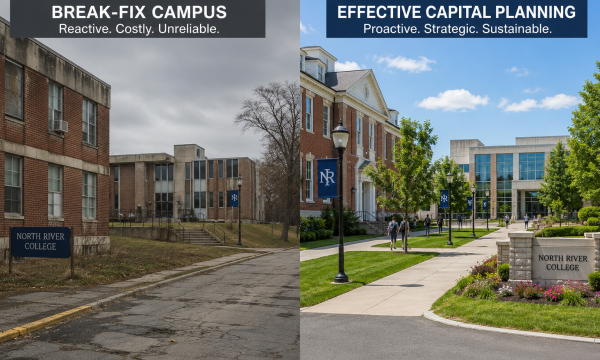
Why Structured Facilities Planning Is a Leadership Responsibility—Not Just an Operational Task
Institutional capital planning is a governance responsibility — not just an operational one.
Executive Summary
For small and mid-sized colleges, universities, and preparatory schools, institutional confidence is one of the most valuable—and fragile—assets.
Trustees, donors, lenders, accrediting bodies, and prospective students all evaluate an institution not only on its academic offerings, but on its stability, discipline, and long-term viability.
At the center of that evaluation lies an often underappreciated factor:
How well the institution stewards its physical assets.
This paper explores how structured, data-driven capital planning strengthens governance, reinforces fiduciary responsibility, and builds confidence across all stakeholders.
Facilities Are a Governance Issue
Institutional leadership carries fiduciary responsibility for:
- Financial assets
- Human capital
- Academic outcomes
- Physical infrastructure
For many institutions, physical assets represent one of the largest categories on the balance sheet.
Yet facilities are often discussed operationally rather than strategically.
This creates a disconnect:
- Trustees think in terms of risk and financial exposure
- Facilities teams think in terms of systems and conditions
Bridging this gap is essential.
The Role of Trustees and Executive Leadership
Trustees and executive leaders are responsible for ensuring:
- Long-term institutional sustainability
- Responsible allocation of capital
- Transparency in financial planning
- Risk mitigation across all asset categories
When it comes to facilities, this responsibility includes:
✔ Understanding the condition of physical assets
✔ Quantifying deferred maintenance liability
✔ Ensuring capital planning aligns with financial capacity
✔ Avoiding unmanaged risk exposure
Without structured information, these responsibilities become difficult to fulfill.
What Confidence Looks Like to Stakeholders
Different stakeholders interpret facilities stewardship in different ways:
| Stakeholder | What They Look For | What Facilities Signal |
|---|---|---|
| Trustees | Risk management, planning discipline | Are we managing long-term obligations? |
| Donors | Responsible stewardship | Will contributions be well-managed? |
| Lenders | Financial stability | Are assets being maintained and protected? |
| Accrediting Bodies | Institutional sustainability | Is there a long-term plan? |
| Students & Families | Quality and experience | Is this a stable, well-run institution? |
Facilities condition and planning are not isolated—they influence institution-wide perception.
The Impact of Structured Capital Planning
Institutions that implement structured capital planning see measurable benefits across governance and leadership functions.
1. Reinforces Fiscal Discipline
A multi-year capital plan:
- Establishes predictable funding needs
- Reduces reliance on emergency spending
- Aligns capital requests with financial strategy
👉 Insert Graphic: Planned vs. Reactive Spending Curve
2. Enhances Board Confidence
Boards are more effective when they have:
- Clear, data-driven insight
- Prioritized capital needs
- Defined timelines and cost projections
This transforms conversations from:
“What do we need to fix?”
To:
“What is our long-term strategy?”
3. Supports Financing and Bond Discussions
Lenders and financial partners evaluate:
- Asset condition
- Capital planning discipline
- Risk exposure
Institutions with structured plans can:
- Demonstrate control over future liabilities
- Improve borrowing confidence
- Strengthen financial positioning
4. Strengthens Donor Trust
Donors are more likely to invest when they see:
- Responsible stewardship
- Clear priorities
- Transparent planning
Capital planning becomes a tool for:
- Communicating need
- Justifying investment
- Demonstrating impact
5. Signals Institutional Stability
Perhaps most importantly, structured planning communicates:
- Leadership awareness
- Strategic intent
- Organizational discipline
These signals influence:
- Enrollment decisions
- Faculty recruitment
- External partnerships
Quantifying Deferred Maintenance: The Turning Point
Many institutions struggle not because they lack commitment—but because they lack clarity.
Common Challenges
- No comprehensive facility data
- Limited understanding of system conditions
- Inability to quantify deferred maintenance
- Reactive, anecdotal decision-making
The Shift
Institutions that quantify deferred maintenance gain:
- Visibility into total capital exposure
- Ability to prioritize based on risk
- A foundation for long-term planning
| Building | System | Condition | Est. Cost | Priority |
|---|---|---|---|---|
| Residence Hall A | HVAC | Poor | $450,000 | High |
| Science Building | Roof | Fair | $220,000 | Medium |
| Admin Building | Electrical | Good | $75,000 | Low |
From Facilities Data to Executive Strategy
Data alone is not enough.
It must be translated into decision-ready insight.
Key Elements of Effective Reporting
- Clear prioritization (what matters most)
- Financial framing (cost, risk, timing)
- Multi-year projections
- Alignment with institutional strategy
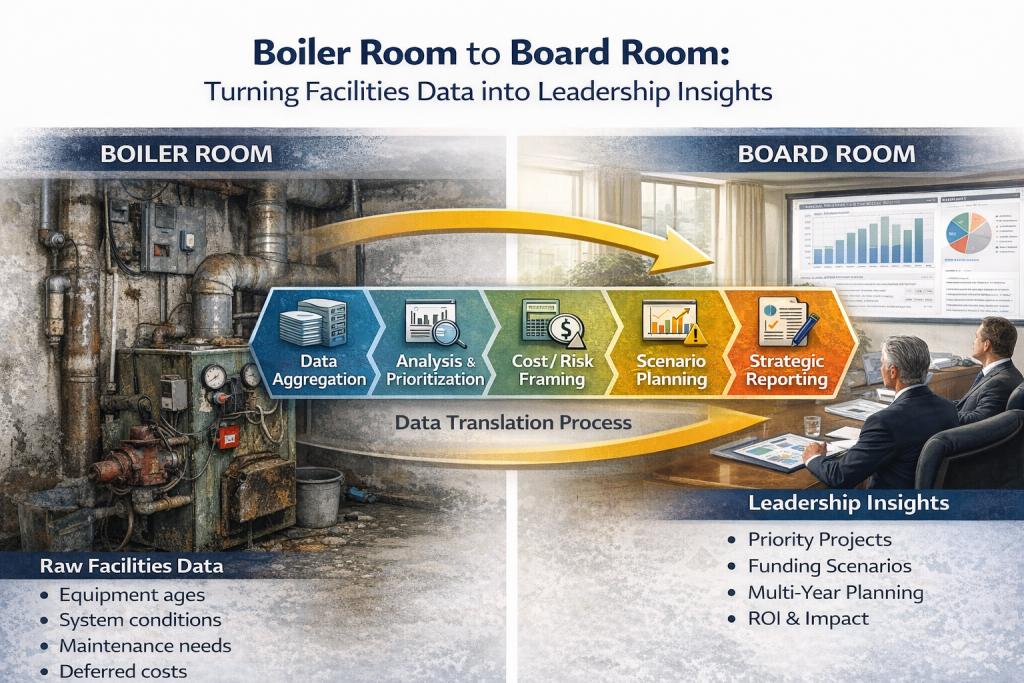
This enables leadership to:
- Make informed decisions
- Communicate effectively with stakeholders
- Demonstrate governance strength
Case Scenario: Confidence Through Planning
Institution A: Unstructured Approach
- No formal capital plan
- Deferred maintenance unknown
- Frequent emergency repairs
- Board uncertainty regarding risk
Institution B: Structured Approach
- Completed facility condition assessment
- Developed 10-year structured institutional capital planning approach
- Prioritized high-risk systems
- Presented clear strategy to board
Result:
- Improved board confidence
- Stronger financial positioning
- Increased donor engagement
- Reduced operational volatility
How AmBIT Supports Institutional Leadership
AmBIT partners with institutions to bring clarity, structure, and confidence to facilities planning.
Our approach includes:
- Objective facility condition assessments
- Deferred maintenance quantification
- Risk-priority scoring models
- Multi-year capital planning aligned with funding reality
- Executive-ready reporting for boards and leadership
We help institutions communicate a powerful message:
We understand our risks.
We have a plan.
We are stewarding our assets responsibly.
Conclusion
Facilities stewardship is not just an operational responsibility.
It is a governance imperative.
Institutions that proactively assess, quantify, and plan for their capital needs demonstrate:
- Fiscal discipline
- Strategic leadership
- Institutional stability
In an increasingly competitive and scrutinized environment, these qualities are not optional.
They are essential.
Because ultimately:
Confidence is built on clarity.
And clarity begins with understanding—and planning for—your assets.

Written by
AmBIT Author