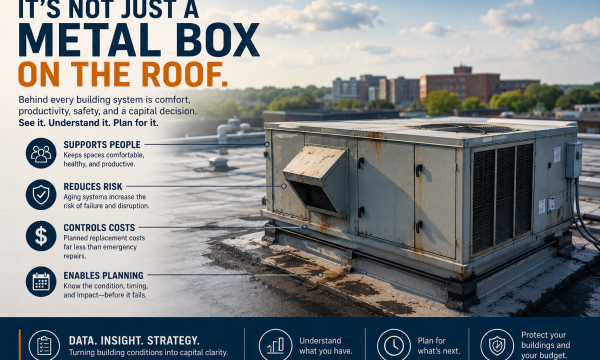
A defensible facility data capital plan requires more than a checklist — it takes expertise, context, and clear translation from technical findings to financial strategy.
Executive Summary
Facility assessments have become more common across industries, but not all assessments deliver equal value. While many organizations now possess data about their buildings, far fewer are equipped to translate that data into a clear, actionable, and defensible capital plan.
The difference lies not in the quantity of data collected—but in the quality of the assessment and the expertise behind its interpretation.
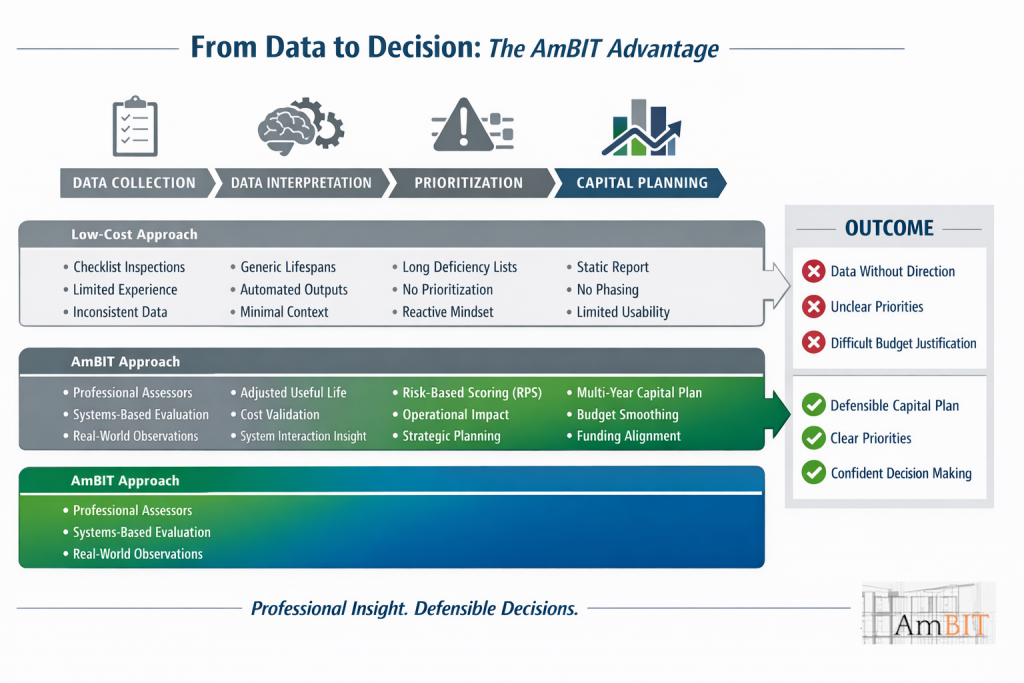
Organizations that rely on low-cost, checklist-driven assessments often find themselves with reports that lack context, prioritization, and practical application. In contrast, assessments conducted and interpreted by experienced facilities professionals provide something far more valuable:
- Insight grounded in real-world building performance
- Prioritization aligned with operational risk
- Guidance that connects technical findings to financial strategy
This paper explores how organizations can move beyond static reports and develop capital plans that are structured, strategic, and actionable—and why professional expertise is essential at every step of that journey.
The Gap Between Facility Data and a Capital Plan
Many organizations have taken the important first step of conducting a Facility Condition Assessment (FCA). However, a common challenge quickly emerges:
“We have the data—but what do we do with it?”
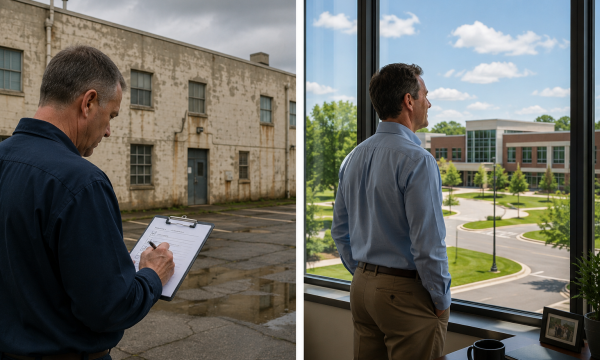
Too often, assessment reports become static documents—filed away after completion, referenced only when a failure occurs or a budget request is needed.
This gap exists because:
- Data is presented without clear prioritization
- Costs are listed without timing or phasing
- Findings lack operational or financial context
- Decision-makers are left to interpret technical information on their own
Without a structured approach, even high-quality data can fail to drive meaningful action.
Not All Assessments Are Created Equal
As demand for facility assessments has grown, so too has the range of providers. Many organizations are drawn to lower-cost options that promise fast turnaround and broad coverage.
However, these services often rely on:
- Lightly trained assessors
- Checklist-based inspections
- Limited understanding of building systems and lifecycle behavior
The result is predictable:
- Misidentified or overlooked deficiencies
- Inaccurate remaining useful life estimates
- Costs that do not reflect real-world conditions
- Reports that lack credibility with leadership
Why Professional Expertise Matters
A meaningful assessment requires more than observation—it requires interpretation.
Experienced facilities professionals bring:
- Deep knowledge of system lifecycles (e.g., BOMA standards adjusted by observed condition)
- Understanding of how systems fail—and how failure impacts operations
- Ability to distinguish between cosmetic issues and critical risks
- Real-world cost awareness based on actual projects
This expertise transforms an assessment from a data collection exercise into a decision-making tool.
Structuring Data for Action
Once collected, data must be organized in a way that supports planning.
A structured framework typically includes:
- System-level inventory (aligned with Uniformat II)
- Condition assessments and deficiencies
- Replacement and repair costs
- Observed remaining useful life
But structure alone is not enough.
Professional interpretation ensures that:
- Lifespans are adjusted based on actual condition—not just age
- Costs reflect realistic construction conditions
- Redundant or overlapping scopes are identified
- Recommendations are practical and implementable
Prioritization: Moving Beyond the List
A list of deficiencies is not a plan.
To move forward, organizations must prioritize based on risk and impact. One effective approach is a structured scoring model, such as:
Risk Priority Score (RPS) = Severity × Probability × Impact
Where:
- Severity reflects the consequence of failure
- Probability reflects likelihood of occurrence
- Impact considers operational, financial, and safety effects
Professional judgment is critical here.
An experienced assessor understands:
- Which issues pose immediate operational risk
- Which can be deferred without consequence
- How multiple deficiencies may interact
- When timing adjustments can reduce overall cost
This level of insight cannot be replicated through automated or checklist-based approaches.
Building the Capital Plan
With prioritized data in hand, the next step is developing a multi-year capital plan.
Key components include:
Phasing and Timing
- Aligning projects with system lifecycles
- Avoiding clustering of major expenditures
- Coordinating related scopes
Budget Smoothing
- Using approaches such as flat-line budgeting
- Distributing costs over remaining useful life
- Reducing volatility in annual funding needs
Alignment with Funding Cycles
- Matching capital needs with available funding windows
- Supporting grant, bond, or financing strategies
Defensibility
- Ensuring all recommendations are supported by objective data
- Providing clear rationale for timing and prioritization
A well-developed capital plan shifts the conversation from:
“What failed?”
to
“What is our strategy?”
From Technical Data to Executive Communication
One of the most overlooked aspects of capital planning is communication.
Facility data must be translated into terms that resonate with:
- Finance teams
- Executive leadership
- Boards and stakeholders
This requires:
- Clear summaries of risk and need
- Visual tools (e.g., FCI trends, funding curves)
- Alignment with organizational goals
Professionals with real-world experience are uniquely positioned to bridge this gap—connecting technical findings with strategic decision-making.
Maintaining a Living Plan
A capital plan is not a one-time deliverable—it is a living framework.
Best practices include:
- Periodic reassessment (e.g., every 5 years)
- Rolling updates (e.g., 20% of buildings annually)
- Continuous database updates as projects are completed
Organizations that maintain current data are better equipped to:
- Respond to changing conditions
- Adjust priorities
- Plan proactively rather than reactively
The AmBIT Approach: Expertise at Every Step
At AmBIT, we believe that the value of an assessment is defined not by the volume of data collected, but by the quality of insight delivered.
Our approach is built on:
Professional Assessors
Assessments are conducted by experienced facilities professionals—not data collectors—ensuring accuracy, consistency, and credibility.
Real-World Interpretation
We apply practical experience to:
- Adjust lifespans based on observed conditions
- Validate costs against actual market conditions
- Identify risks that may not be immediately apparent
Strategic Consulting
Beyond the assessment, we work directly with clients to:
- Develop actionable capital plans
- Prioritize investments
- Communicate effectively with leadership
Objective, Unbiased Perspective
Because we are not in the construction business, our recommendations are focused solely on what is best for the client’s assets and operations.
Conclusion: From Information to Insight
Facility data, on its own, does not drive better outcomes.
It is the combination of:
- Accurate assessment
- Professional expertise
- Structured planning
that transforms information into actionable strategy.
Organizations that invest in experienced professionals—both in the assessment phase and in ongoing consulting—position themselves to make better decisions, reduce risk, and steward their assets with confidence.
Call to Action
If your organization has assessment data but lacks a clear path forward—or if you are evaluating assessment options—it is worth asking:
Will this process give us information… or will it give us insight?
AmBIT partners with organizations to deliver both.

Written by
AmBIT Author