How to Turn Your Facility Condition Assessment Into Better Buildings, Better Planning, and Better Financial Outcomes
A Facility Condition Assessment (FCA) represents one of the most valuable investments an institution can make in understanding its facilities.
It provides objective data.
It identifies deficiencies.
It estimates remaining useful life.
It forecasts future capital needs.
It establishes priorities.
But perhaps the most important question begins after the final report is delivered.
Now what?
Far too many Facility Condition Assessments become expensive reports that are reviewed briefly, presented to leadership, and then quietly placed on a shelf.
The organizations that realize the greatest return on their investment take a very different approach.
They use the assessment as a roadmap—not merely a report.
Every recommendation becomes an opportunity.
Every identified deficiency becomes an informed decision.
Every capital forecast becomes a strategic planning tool.
The assessment becomes the foundation for a continuous improvement process that strengthens facilities, improves financial planning, enhances reliability, and ultimately creates a better environment for students, faculty, and staff.
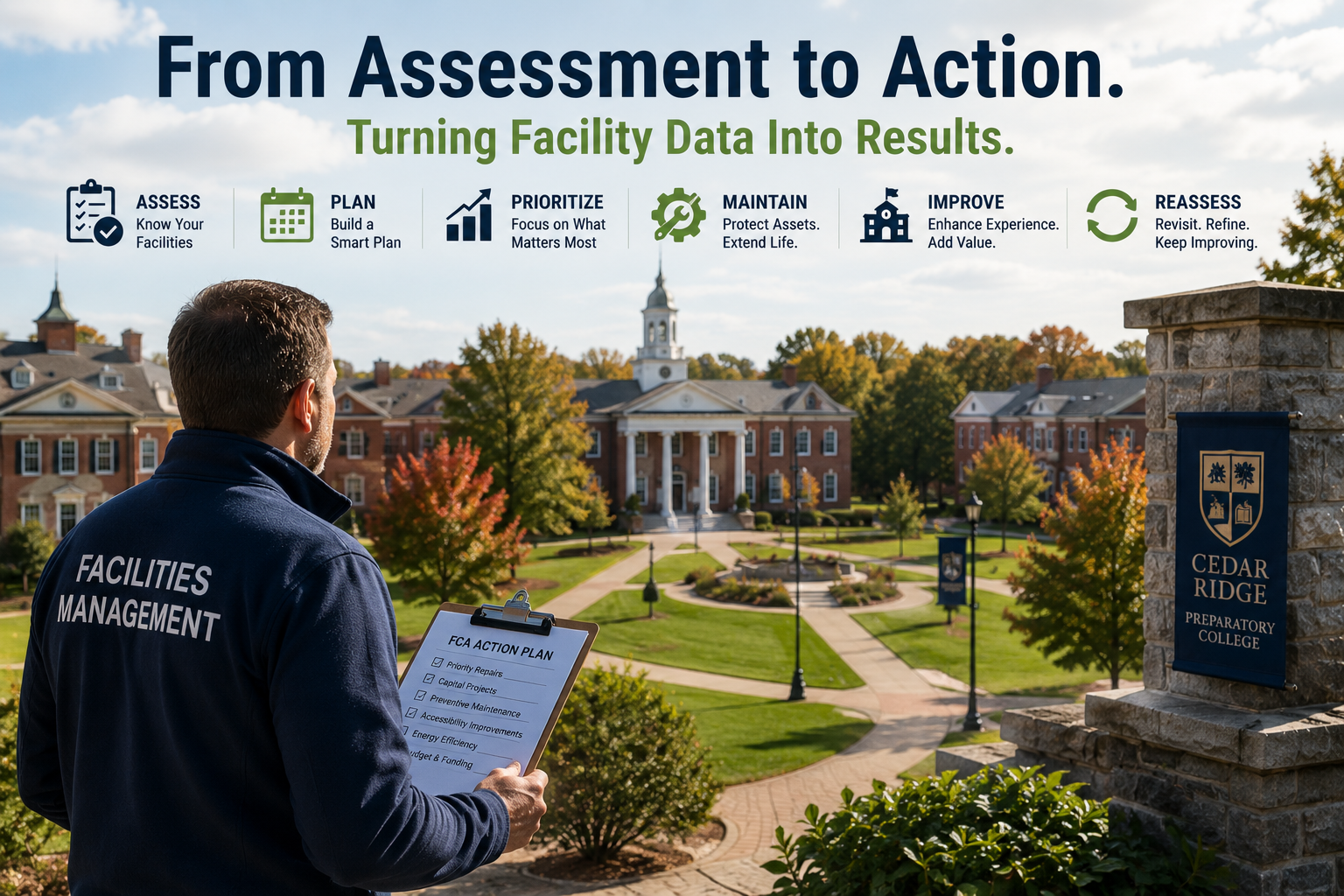
Let’s follow a fictional institution through that process.
Meet Our Client
For this example, consider Cedar Ridge Preparatory College, a fictional independent college located in the Northeast.
Campus Profile
- 26 buildings
- Approximately 375,000 square feet
- Residence halls
- Academic buildings
- Student center
- Athletic facilities
- Administration building
- Performing arts center
- Maintenance complex
The college has just completed its first comprehensive Facility Condition Assessment with AmBIT.
The report identifies:
- $8.2 million in deferred maintenance
- Approximately $18 million in projected capital needs over twenty years
- Several high-risk mechanical systems
- Roofing nearing end of useful life
- Numerous ADA accessibility improvements
- Opportunities to reduce operating costs through preventive maintenance
Rather than viewing the report as a list of problems, campus leadership sees something else.
A plan.
Step One: Prioritize Risk
The first reaction to an FCA is often overwhelming.
There may be hundreds—or even thousands—of observations.
Not everything should be addressed immediately.
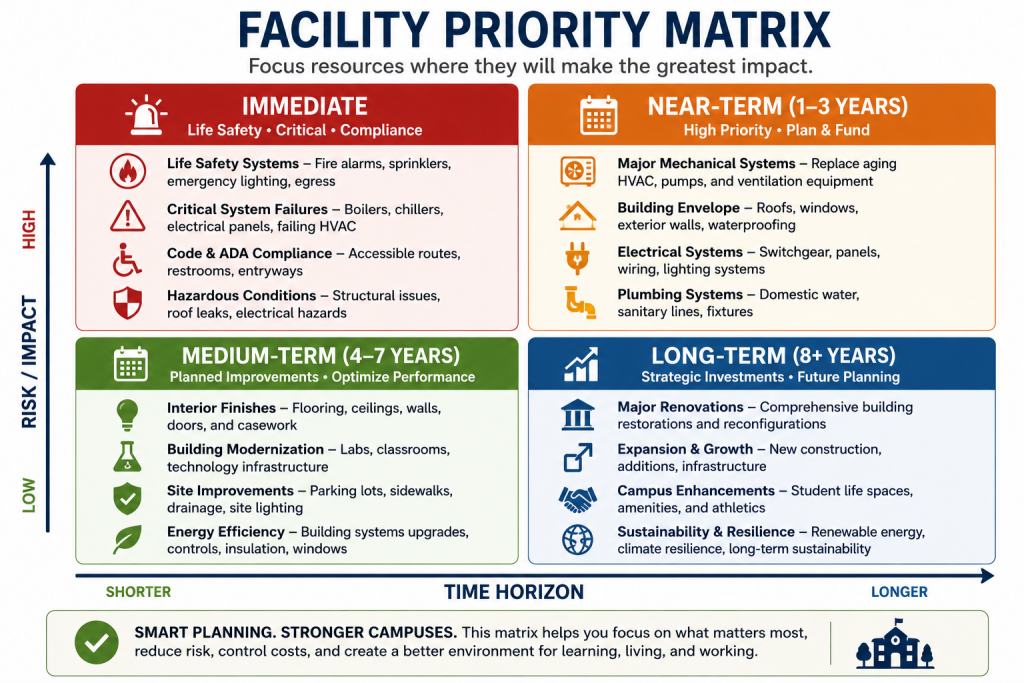
One of the greatest benefits of working with experienced facility consultants is transforming a long list of observations into an organized action plan.
Projects can be categorized as:
Immediate
- Life safety issues
- Critical system failures
- Regulatory concerns
Near-Term (1–3 Years)
- High-risk capital projects
- Major maintenance initiatives
- Equipment nearing end of life
Medium-Term (4–7 Years)
- Planned replacements
- Building modernization
- Energy improvements
Long-Term
- Strategic renovations
- Campus renewal initiatives
- Future expansion opportunities
Instead of reacting emotionally to deficiencies, leadership begins making informed, objective decisions.
Step Two: Build the Capital Plan
The FCA has already estimated remaining useful life for major building systems.
Now those projections become a financial planning tool.
Instead of asking:
“What broke this year?”
Leadership begins asking:
“What should we replace next year?”
Capital requests become predictable.
Reserve funding becomes intentional.
Budgets become more stable.
Trustees gain confidence because decisions are supported by objective facility data.
Pro Forma Example
Before FCA
Annual emergency capital spending:
Approximately $1.2 million
Highly unpredictable
Several emergency approvals each year
After FCA
Annual planned capital spending:
Approximately $900,000
Emergency spending reduced to approximately $250,000
Annual emergency savings:
Approximately $950,000
Step Three: Improve Preventive Maintenance
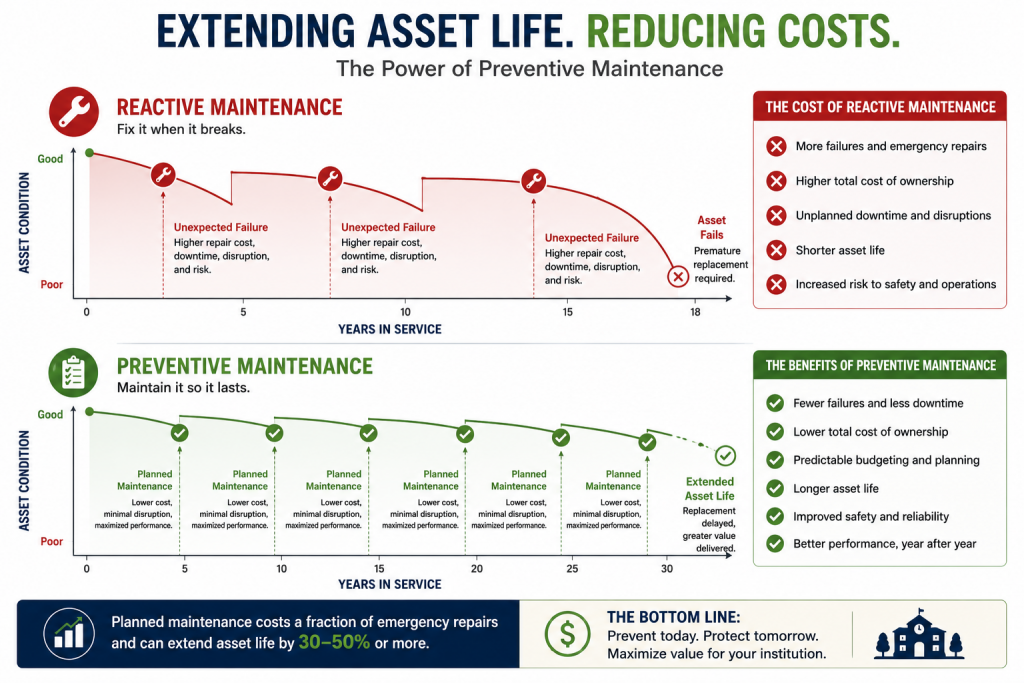
One surprising outcome of many FCAs is identifying opportunities to improve maintenance practices.
Sometimes the equipment itself isn’t the primary problem.
The maintenance strategy is.
Using FCA findings, maintenance staff can:
- Adjust inspection frequencies
- Improve documentation
- Replace high-failure components proactively
- Modify seasonal maintenance schedules
- Improve inventory management
The result is often longer equipment life with relatively modest investment.
Pro Forma Example
Preventive maintenance improvements increase average HVAC equipment life from:
18 years
to
24 years
Across multiple buildings, that six-year extension may delay millions of dollars in capital replacement.
Step Four: Bundle Projects
One of the most overlooked advantages of an FCA is project coordination.
Instead of replacing roofs one year and HVAC equipment the following year, projects can often be combined.
Examples include:
Roof replacement
Rooftop unit replacement
Lighting upgrades
Solar readiness
performed during one mobilization.
The institution saves:
- Contractor mobilization costs
- Temporary protection costs
- Occupant disruption
- Administrative effort
The result is better value from every construction dollar.
Pro Forma Example
Separate projects:
$4.3 million
Bundled projects:
$3.85 million
Estimated savings:
Approximately $450,000
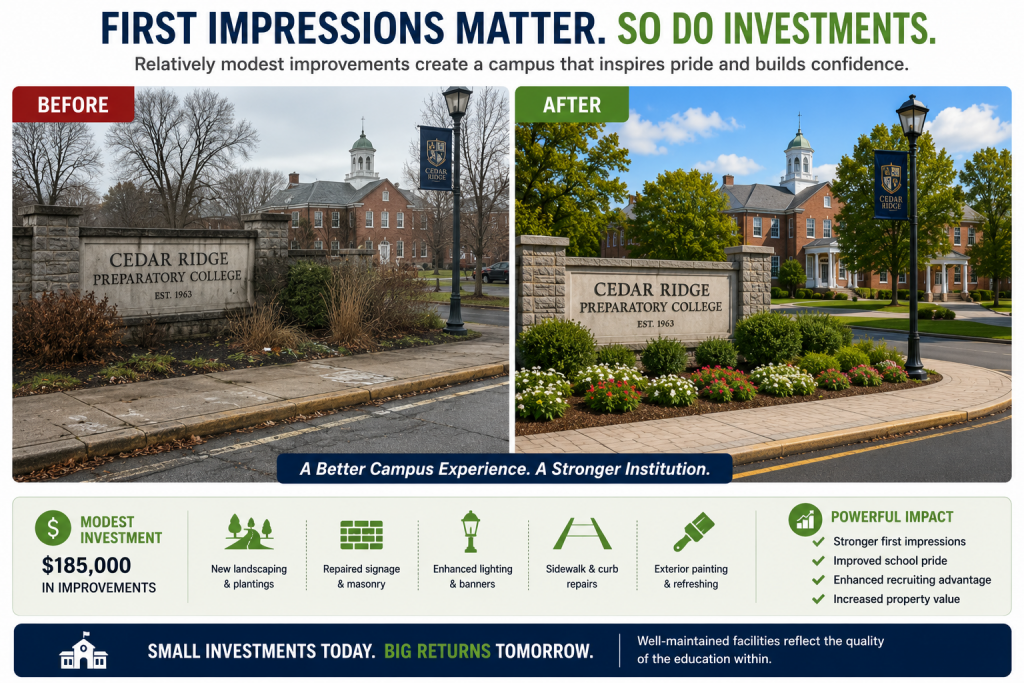
Step Five: Improve the Campus Experience
Some recommendations are not particularly expensive.
Yet they have an outsized impact.
Examples include:
- Improved lighting
- Updated signage
- Sidewalk repairs
- Accessible entrances
- Landscape improvements
- Exterior painting
- Interior finish upgrades
Prospective students notice these improvements immediately.
Parents notice them.
Faculty notice them.
Alumni notice them.
The campus begins communicating stewardship and investment.
One Chance to Make a First Impression:
Step Six: Support Fundraising and Strategic Planning
Facility data has value beyond maintenance.
Many institutions use FCA information to support:
Capital campaigns
Grant applications
Bond financing
Donor discussions
Master planning
Deferred maintenance funding requests
When trustees and donors see objective data supported by professional analysis, funding conversations become more compelling.
Step Seven: Measure Progress
The assessment should never become a static document.
Every completed project should improve the overall condition of the campus.
Over time, leadership can monitor:
Deferred maintenance backlog
Facility Condition Index
Capital expenditures
Emergency repairs
Energy performance
System reliability
The institution begins measuring progress rather than simply responding to problems.
Pro Forma Example
Year One
Deferred Maintenance:
$8.2 Million
Facility Condition Index:
11%
Year Five
Deferred Maintenance:
$5.1 Million
Facility Condition Index:
7%
Campus appearance:
Significantly improved
Emergency work orders:
Reduced by 42%
Student satisfaction:
Improved
Step Eight: Continue the Partnership
Perhaps the most important recommendation comes five years later.
Buildings continue aging.
Systems continue changing.
Capital projects have been completed.
Others have emerged.
The Facility Condition Assessment should evolve with the campus.
Most institutions benefit from updating their FCA approximately every five years.
The update:
Verifies completed work
Adjusts remaining useful life
Updates construction costs
Recalculates deferred maintenance
Identifies newly emerging priorities
Refines long-term capital forecasts
Rather than starting over, the institution builds upon an already strong foundation.
The process becomes continuous improvement.
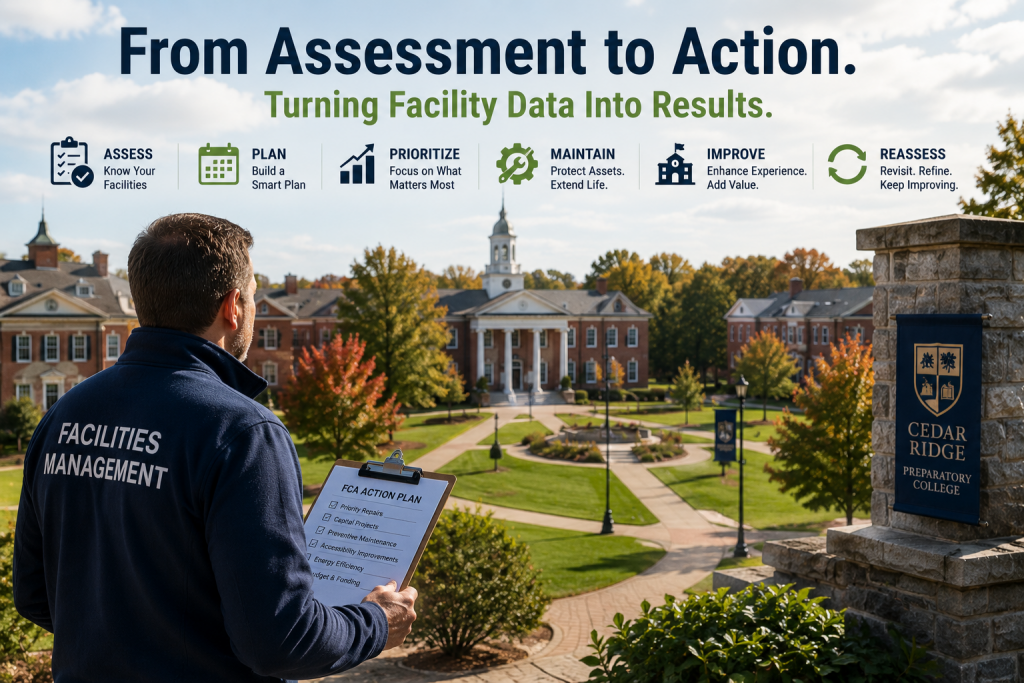
The Greatest Value Is the Partnership
Facility Condition Assessments provide data.
But data alone does not improve buildings.
People do.
The most successful institutions combine:
Professional facility consultants
Campus leadership
Facilities directors
Maintenance staff
Finance officers
Trustees
Working together toward a common objective.
The result is more than improved buildings.
It is improved stewardship.
Improved planning.
Improved reliability.
Improved campus competitiveness.
And ultimately, a better experience for everyone who learns, teaches, works, and visits there.
Looking Forward
A Facility Condition Assessment should never be viewed as the finish line.
It is the starting point for smarter decisions.
At AmBIT Asset Capital Solutions, we believe the true value of an FCA is realized not when the report is delivered, but when the recommendations begin shaping the future of the campus.
Our role extends beyond assessment.
We work alongside our clients to interpret findings, establish priorities, evaluate alternatives, coordinate capital planning strategies, and support implementation over time.
Because the best Facility Condition Assessment is not the one that identifies the most deficiencies.
It is the one that helps an institution make the best decisions.

Written by
AmBIT_Admin