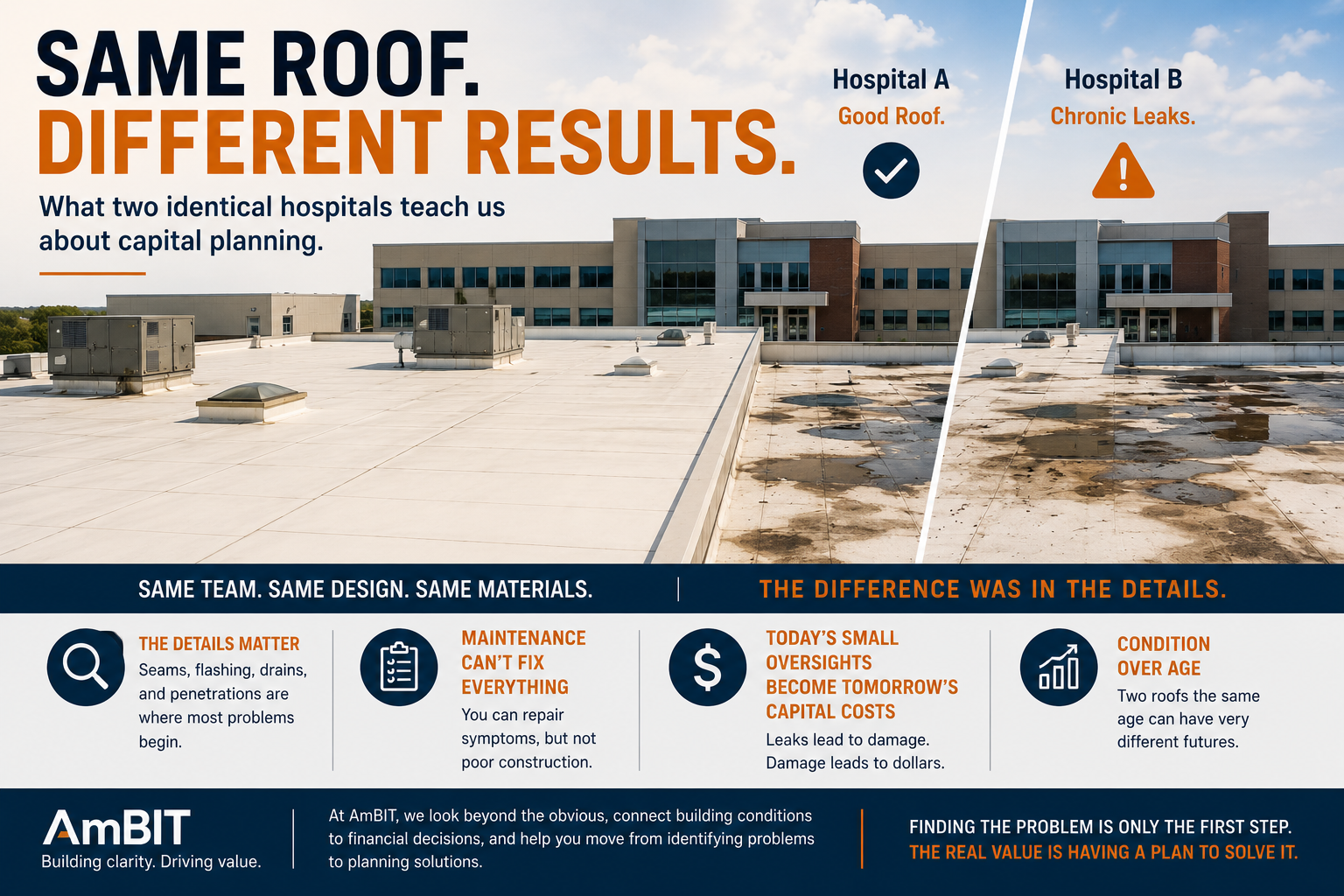
Sometimes the biggest capital planning lessons come from buildings that look exactly the same.
I once assessed two rehabilitation hospitals located about 100 miles apart.
The first assessment was straightforward. The roof was in excellent condition. No history of chronic leaks. No patchwork repairs. No mysterious ceiling stains that appeared every time it rained. Considering the building was less than five years old, everything looked exactly as it should.
The next day, I arrived at the second hospital.
At first glance, I thought I had driven back to the first property by mistake.
The buildings looked nearly identical.
Same footprint. Same exterior. Same roof design. Same general layout.
But their stories were completely different.
Same Building. Different Outcome.
As we walked the second facility, I made what seemed like a reasonable assumption.
“I assume this roof has been good like the last one?”
The owner’s representative looked at me and replied:
“Nope.”
That answer usually means there is a story coming.
And there was.
Both hospitals were developed using essentially the same project team:
- Same architect
- Same engineers
- Same contractor
- Same subcontractors
- Same owner’s representative
- Same administrators
Even the roofing systems were nearly identical. On paper, there was no reason one roof should perform differently than the other.
Yet one roof was performing perfectly.
The other leaked constantly.
The Difference Wasn’t the Design
The owner’s representative explained that the difference came down to one thing:
The roofing foreman.
At the first hospital, the foreman closely supervised the installation. Details were checked. Problems were corrected. Work was performed as designed.
At the second hospital, supervision was inconsistent. Small details were overlooked. Flashings, penetrations, seams, and transitions did not receive the same attention.
The roof was completed.
The contractor moved on.
Then the problems started.
A Roof Is Really a Collection of Details
Most people see a roof as one large surface.
Roofing professionals know better.
A roof is actually a collection of hundreds of details working together:
- Seams
- Drains
- Curbs
- Penetrations
- Flashings
- Edges
- Transitions
The large open sections are rarely where failures begin.
It is almost always the details.
A seam that wasn’t fully secured.
A penetration that wasn’t sealed correctly.
A flashing detail that looked acceptable from a distance but wasn’t installed properly.
Individually, these issues seem small.
Collectively, they determine whether water stays outside or finds its way inside.
The two hospitals opened looking almost identical.
Over time, their performance told a very different story.
Facilities Inherit Every Decision
Once construction is complete, the installers leave.
The facilities team stays.
And they inherit every detail of the construction process—whether those details were done correctly or not.
At the first hospital, roof maintenance looked exactly as it should:
- Routine inspections
- Drain cleaning
- Normal repairs
- Preventive maintenance
At the second hospital, maintenance became something else entirely:
- Recurring leaks
- Damaged ceiling tiles
- Wet insulation
- Interior disruption
- Constant service calls
A small construction issue eventually became a long-term maintenance issue.
Then the maintenance issue became a capital issue.
That progression happens more often than many organizations realize.
Buildings Keep Better Records Than We Think
One lesson becomes clear after walking enough facilities:
Buildings keep score.
Not in spreadsheets.
Not in reports.
In the building itself.
Water stains reveal failures.
Patches reveal history.
New ceiling tiles surrounded by old ones reveal recurring problems.
Buildings remember every repair, every shortcut, and every time someone decided a detail was “probably good enough.”
Years later, a Facility Condition Assessment (FCA) captures the results.
What started as a small oversight eventually shows up as:
- Accelerated deterioration
- Increased maintenance costs
- Reduced useful life
- Capital replacement needs
The building remembers, even when everyone else has forgotten.
Expected Life Is Not Actual Condition
One of the biggest mistakes in capital planning is assuming age tells the entire story.
It doesn’t.
Two roofs may have:
- The same installation date
- The same size
- The same roofing system
- The same expected life
Yet perform completely differently.
Expected life assumes:
- Proper installation
- Good workmanship
- Reasonable maintenance
- Normal environmental exposure
Change any of those variables, and actual performance changes too.
That is why condition matters more than age alone.
A capital plan based solely on installation dates may appear organized.
It may also miss what is actually happening inside the building.
Maintenance Can’t Fix Everything
The facilities team at the second hospital did exactly what good facilities teams do.
They kept the building operational. They responded to leaks, coordinated repairs, protected occupants, and minimized disruption.
That work matters.
But maintenance cannot undo poor construction.
Facilities teams can repair symptoms.
They cannot travel back in time and correct the original installation.
Eventually the conversation changes.
It stops being:
“How do we repair this leak?”
And becomes:
“How much longer does it make sense to keep repairing this roof?”
That is where maintenance and capital planning intersect.
The Difference Was a Person
What makes this story memorable is how simple the lesson is.
The buildings were nearly identical.
The drawings were the same.
The materials were the same.
The contractors were the same.
The difference was a person.
One foreman paid attention to the details.
The other did not.
That difference followed both buildings for years. One roof quietly did its job. The other became a recurring item in maintenance reports, operating budgets, and eventually the capital plan.
Capital problems do not always begin with catastrophic failures.
Sometimes they begin with a small detail that was overlooked, covered up, and forgotten.
Forgotten by everyone except the building.
The building always remembers.
Why This Matters
Good capital planning is not just about understanding asset age.
It is about understanding asset condition.
It is about looking beyond assumptions, identifying risk before it becomes expensive, and understanding the story a building is trying to tell.
At AmBIT, we believe the details matter because that is often where the real story begins. We look beyond the obvious, connect building conditions to financial decisions, and help organizations move from identifying problems to planning solutions.
Because finding the problem is only the first step.
The real value is having a plan to solve it.

Written by
AmBIT Author