Why Small College Campuses Must Invest in Their Facilities to Survive
Small college campus facilities are often treated as a cost to defer — but neglect compounds quietly until it becomes a crisis.
Executive Summary
Why Small College Campus Facilities Can’t Afford Neglect
Across the country, small private colleges are facing mounting financial pressure. Declining enrollment, rising operational costs, and increased competition have forced institutional leaders to make difficult decisions—often with limited resources and little margin for error.
In this environment, facilities are frequently viewed as a cost center to be deferred.
This is a critical mistake.
Campus conditions play a direct and measurable role in:
- Student recruitment and retention
- Operational efficiency and cost control
- Institutional credibility with donors, boards, and lenders
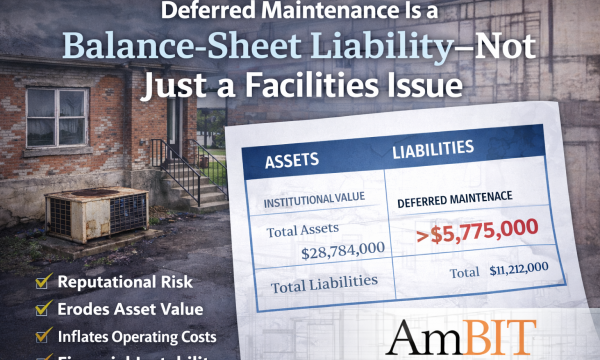
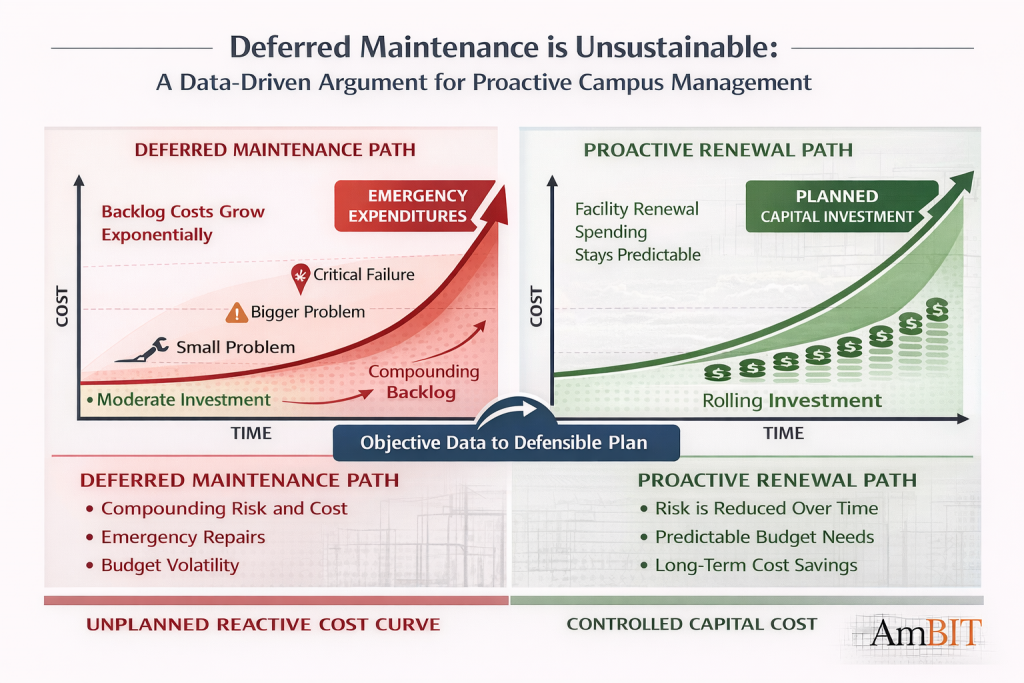
Deferred maintenance does not eliminate cost—it compounds it. What begins as a manageable repair can quickly escalate into a major capital failure, disrupting operations and straining already limited budgets.
Colleges that take a proactive, data-driven approach to facility management position themselves differently. They gain clarity, control, and the ability to make strategic decisions with confidence.
AmBIT works with institutions to provide exactly that: objective facility data, professional insight, and actionable capital planning—helping leadership teams move from uncertainty to strategy.
A Growing Challenge for Small Colleges
The financial model for many small private institutions is under strain. Unlike large universities with significant endowments, smaller colleges often operate with:
- Limited capital reserves
- Deferred maintenance backlogs
- Aging infrastructure
- Competing budget priorities
When financial pressure increases, facilities are often one of the first areas where spending is reduced.
The result is a slow but dangerous trend:
Facilities degrade quietly—until they fail loudly.
Why Facilities Matter More Than Ever
1. First Impressions Drive Enrollment
Prospective students and families evaluate more than academic programs—they evaluate the entire campus experience.
Outdated residence halls, aging classrooms, and visibly deferred maintenance send a clear message:
- The institution may be struggling
- Investment in student experience may be limited
- Long-term stability may be uncertain
Conversely, well-maintained facilities signal:
- Pride in the institution
- Commitment to student experience
- Operational stability
In a competitive enrollment environment, these perceptions matter.
2. Deferred Maintenance Increases Operating Costs
Aging systems do not fail efficiently.
- HVAC systems operate at reduced efficiency, increasing energy costs
- Minor roof issues become major water intrusion problems
- Deferred maintenance leads to emergency repairs—often at premium cost
What appears to be a cost-saving measure becomes a cost multiplier.
3. Unplanned Failures Disrupt Campus Life
When critical systems fail:
- Classes are relocated or canceled
- Residence halls become uninhabitable
- Events are disrupted
These events impact:
- Student satisfaction
- Retention
- Institutional reputation
4. Leadership Needs Defensible Data
Presidents, CFOs, and boards are increasingly asked to make difficult financial decisions.
Without objective facility data:
- Capital requests are difficult to justify
- Priorities are unclear
- Risk is not well understood
This creates hesitation—and often leads to inaction.
The Real Risk: Operating Without a Plan
Many institutions operate reactively:
- Addressing issues as they arise
- Making decisions based on urgency rather than strategy
- Lacking visibility into future capital needs
This approach leads to:
- Budget volatility
- Competing priorities
- Increased long-term cost
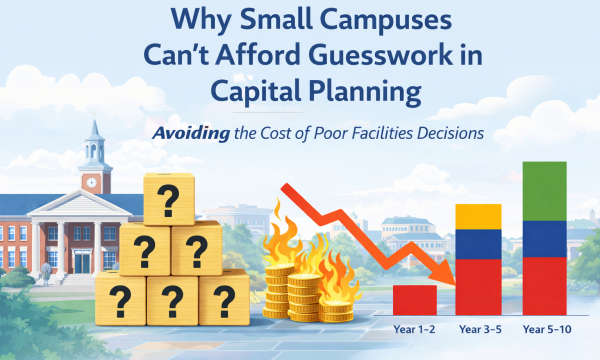
The alternative is a structured, proactive approach grounded in data and professional expertise.
How AmBIT Helps Colleges Regain Control
AmBIT provides a comprehensive, professional approach designed specifically for organizations that need clarity, structure, and confidence in their facility decisions.
1. Facility Condition Assessments (FCA)
Establishing a Clear Baseline
AmBIT conducts detailed, system-level assessments of campus buildings, providing:
- Complete inventory of building systems
- Condition evaluations based on real-world observations
- Identification of deficiencies and risks
- Replacement cost estimates
Unlike low-cost providers, AmBIT assessments are performed by experienced facilities professionals who understand how systems actually perform—not just how they appear.
2. Data-Driven Capital Planning
Turning Information into Strategy
Assessment data is transformed into a structured capital plan that includes:
- Multi-year project phasing
- Prioritization based on risk and impact
- Budget forecasting aligned with funding cycles
This allows leadership to move from:
“What do we fix next?”
to
“What is our long-term strategy?”
3. Risk-Based Prioritization (RPS Framework)
Focusing on What Matters Most
AmBIT helps institutions prioritize projects using a structured approach:
- Severity of potential failure
- Probability of occurrence
- Impact on operations, safety, and finances
This ensures that limited resources are directed where they have the greatest effect.
4. Ongoing Advisory & Professional Insight
Beyond the Report
One of the most critical differentiators is what happens after the assessment.
AmBIT works directly with institutional leadership to:
- Interpret findings
- Adjust priorities as conditions change
- Support budget discussions with clear, defensible data
This ongoing partnership ensures that the plan remains relevant and actionable.
5. Objective, Unbiased Perspective
Focused Solely on the Institution’s Best Interest
Because AmBIT is not involved in construction or contracting:
- Recommendations are unbiased
- Priorities are not influenced by project opportunities
- Guidance is aligned with long-term institutional success
A Better Path Forward
Colleges that proactively invest in understanding and managing their facilities gain:
- Greater control over capital spending
- Reduced risk of unexpected failures
- Improved ability to attract and retain students
- Increased confidence among boards and stakeholders
Most importantly, they gain the ability to plan.
Conclusion: Facilities Are Not a Cost—They Are a Signal
Facilities communicate something powerful to everyone who interacts with your institution:
- Students
- Faculty
- Donors
- Trustees
They signal whether the institution is:
- Maintaining its assets responsibly
- Planning for the future
- Operating with discipline and foresight
In today’s environment, that signal matters more than ever.
Call to Action
If your institution is facing increasing pressure to manage costs while maintaining campus quality, the first step is clarity.
Do you truly understand the condition of your facilities—and what it will take to sustain them?
AmBIT helps colleges answer that question—and build a plan to move forward with confidence.

Written by
AmBIT Author