Moving Beyond “Fix What Fails” to Strategic, Data-Driven Investment
Executive Summary
Small and mid-sized colleges are operating in an increasingly competitive and constrained environment. Enrollment volatility, rising operating costs, and heightened expectations from students and families have made institutional differentiation more critical than ever.
In this context, campus facilities are no longer just operational assets—they are strategic drivers of recruitment, retention, and institutional perception.
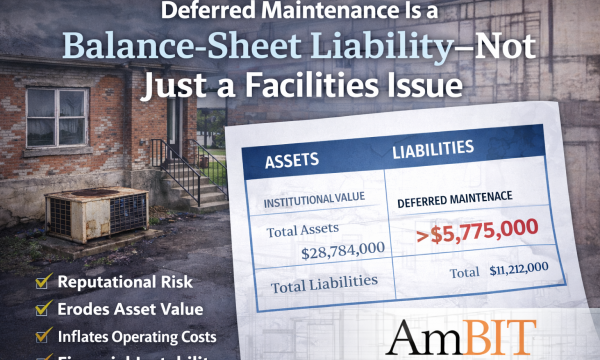
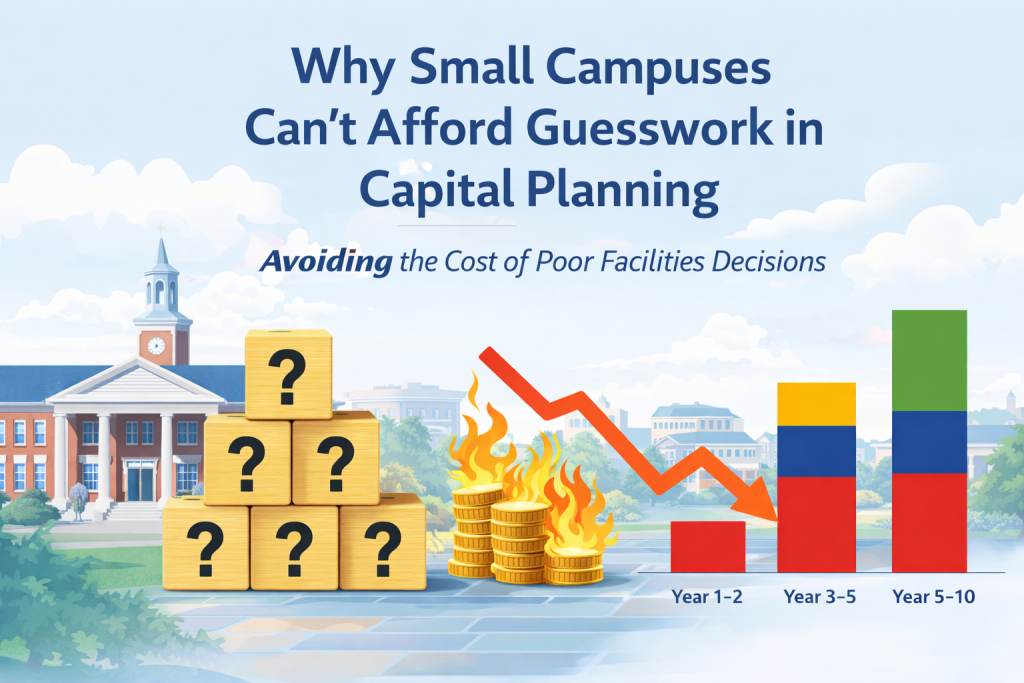
Yet many institutions continue to rely on reactive, anecdotal approaches to capital planning—commonly summarized as “fix what fails.” While this approach may appear cost-effective in the short term, it often leads to higher long-term costs, increased operational risk, and diminished competitiveness.
This paper examines the risks of momentum-based decision-making and outlines how risk-priority scoring and system-level forecasting enable smarter, more strategic investment in campus facilities.
The Competitive Reality for Small Campuses
Higher education is undergoing a structural shift:
- Declining birth rates are reducing the pool of traditional college-aged students
- Prospective students are applying to more schools and comparing campuses more critically
- Families are increasingly value-conscious, weighing cost against perceived quality
- Online and hybrid learning options are expanding competitive alternatives
According to the National Center for Education Statistics, total undergraduate enrollment has experienced sustained pressure over the past decade, particularly among smaller private institutions and regional colleges.
At the same time, campus visits remain one of the most influential decision factors.
Facilities are not peripheral to enrollment—they are central to it.
Facilities as a Differentiator (or a Liability)
When prospective students visit campus, they are evaluating more than academics:
- Residence hall condition
- Classroom comfort (temperature, lighting, acoustics)
- Athletic and recreational facilities
- Grounds and site infrastructure
- Overall campus “feel”
These observations shape perception instantly.
A well-maintained campus communicates:
- Stability
- Investment
- Pride
- Institutional confidence
A poorly maintained campus communicates the opposite—whether leadership intends it or not.
The Problem: Planning by Anecdote
Despite the strategic importance of facilities, many institutions still make capital decisions based on:
- Immediate failures (“this just broke”)
- Visible complaints (“students are noticing this”)
- Historical habits (“we usually replace these every X years”)
- Internal advocacy (“this department needs it most”)
This results in what can be described as momentum-based planning.
The Risks of This Approach
- Misallocation of Capital
- High-risk systems may be deferred
- Low-impact but visible items may be overfunded
- Unpredictable Failures
- Systems fail without warning
- Failures occur during peak academic periods
- Escalating Costs
- Emergency repairs carry premium pricing
- Deferred systems often fail catastrophically rather than gradually
- Damage to Campus Perception
- Visible failures occur during tours, events, or peak occupancy
- Student experience suffers at critical moments
Why “Fix What Fails” Doesn’t Work Anymore
The “fix what fails” model originated in an era of:
- More stable enrollment
- Lower expectations for facilities
- Less competition between institutions
Today, those conditions no longer exist.
The Modern Reality
| Factor | Then | Now |
|---|---|---|
| Enrollment | Stable | Volatile |
| Competition | Regional | National / Global |
| Student Expectations | Moderate | High |
| Cost Sensitivity | Lower | Higher |
| Facilities Role | Operational | Strategic |
In this environment, waiting for failure is not just inefficient—it is strategically risky.
The Financial Impact of Guesswork
Reactive capital planning introduces measurable financial consequences:
1. Cost Escalation
- Deferred systems often require full replacement instead of repair
- Emergency procurement reduces competitive pricing
2. Lost Opportunities for Bundling
- Projects are executed individually instead of strategically grouped
- Mobilization and soft costs increase
3. Operational Disruption
- Academic schedules impacted
- Temporary closures of key facilities
4. Enrollment Impact (Indirect but Real)
- Poor campus impressions during tours
- Reduced student satisfaction and retention
A Better Approach: Risk-Based Capital Planning
Forward-thinking institutions are moving toward data-driven, risk-based planning models.
Key Components
1. System-Level Inventory
A complete understanding of all building systems:
- HVAC
- Roofing
- Electrical
- Plumbing
- Interiors
- Site infrastructure
2. Condition Assessment
Each system is evaluated based on:
- Physical condition
- Performance
- Age vs. expected useful life
3. Risk-Priority Scoring (RPS)
Systems are ranked based on:
- Likelihood of failure
- Consequence of failure (cost, disruption, visibility)
- Impact on student experience
- Safety and compliance considerations
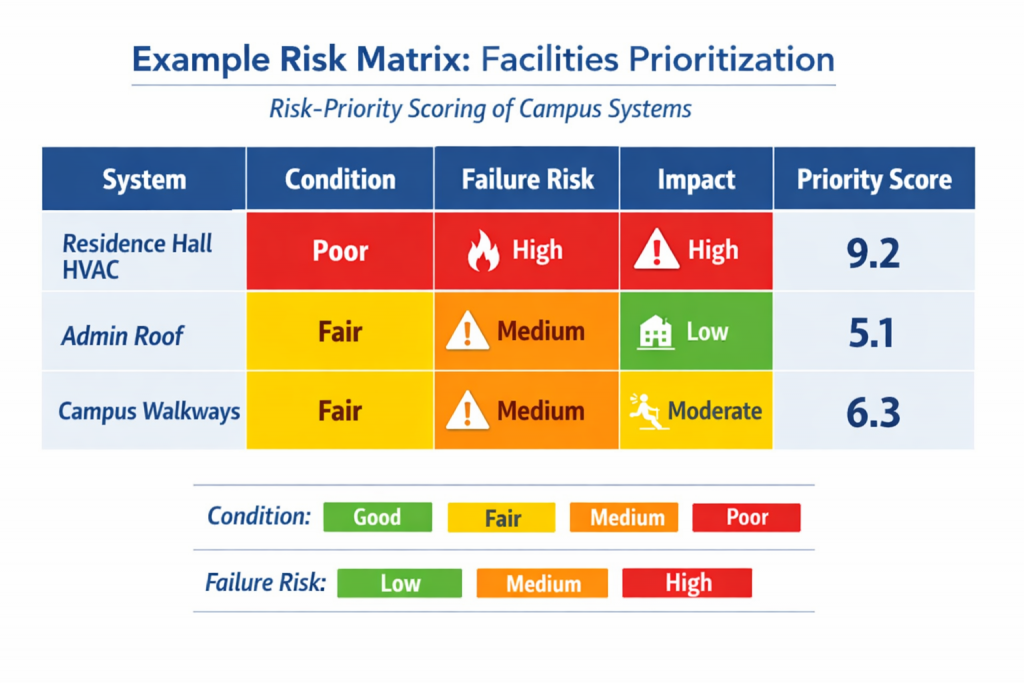
| System | Condition | Failure Risk | Impact | Priority Score |
|---|---|---|---|---|
| Residence Hall HVAC | Poor | High | High | 9.2 |
| Admin Roof | Fair | Medium | Low | 5.1 |
| Campus Walkways | Fair | Medium | Medium | 6.3 |
4. Multi-Year Forecasting
Capital needs are mapped over time:
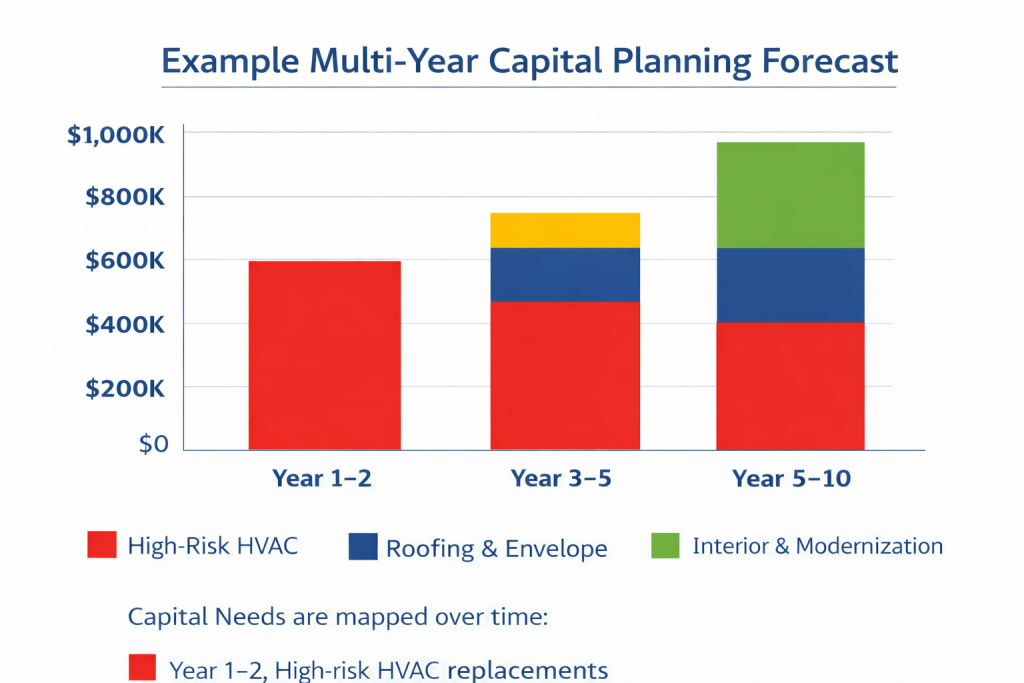
- Year 1–2: High-risk HVAC replacements
- Year 3–5: Roofing and envelope upgrades
- Year 5–10: Interior and modernization projects
Aligning Facilities with Enrollment Strategy
One of the most overlooked opportunities is aligning capital planning with enrollment goals.
High-Impact Investment Areas
- Residence halls (student life experience)
- High-traffic academic buildings
- Admissions tour routes
- Athletic and recreation facilities
- Campus entry points and landscaping
These are not always the most expensive projects—but they are often the most visible and influential.
Case Scenario: Two Approaches
Institution A: Reactive Model
- Defers capital until failure
- Experiences HVAC failure in residence hall during peak summer
- Emergency replacement at premium cost
- Negative student experience during tours
Institution B: Strategic Model
- Uses risk-priority scoring
- Identifies system nearing failure
- Replaces proactively during off-season
- Avoids disruption and controls cost
Same system. Different outcome.
The Role of Objective, Third-Party Data
Internal knowledge is valuable—but it is often:
- Difficult to quantify
- Hard to communicate to boards
- Perceived as subjective
Third-party assessments provide:
- Credibility
- Defensibility
- Consistency
- Executive-level clarity
This transforms conversations from:
“We think this needs attention”
To:
“This system presents a high-probability, high-impact risk within 24–36 months”
How AmBIT Supports Smarter Decision-Making
AmBIT helps institutions replace guesswork with structured, data-driven planning through:
- Comprehensive facility condition assessments
- Risk-priority scoring models
- System-level lifecycle forecasting
- Multi-year capital planning aligned with funding reality
- Executive-ready reporting for leadership and boards
Our goal is simple:
Ensure every capital dollar supports both operational reliability and institutional competitiveness.
Conclusion
Small and mid-sized colleges cannot afford to be average.
And they cannot afford to guess.
In today’s environment, facilities are:
- A recruitment tool
- A retention factor
- A financial asset
- A competitive differentiator
Institutions that rely on reactive planning risk higher costs, greater disruption, and diminished perception.
Those that adopt data-driven, risk-based planning gain clarity, control, and competitive advantage.
Because in modern higher education, your campus isn’t just where students learn—
it’s part of why they choose you.

Written by
AmBIT Author