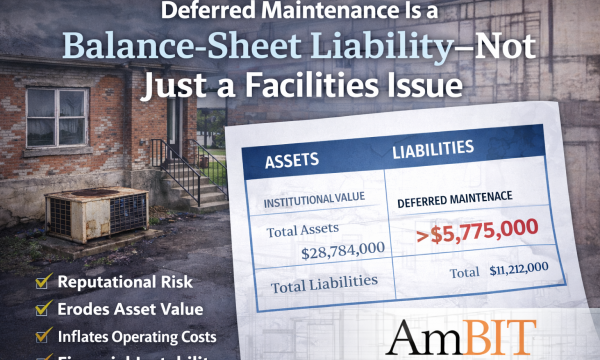
How Targeted Investments Drive Outsized Impact in a Competitive Enrollment Environment
Executive Summary
Small and mid-sized colleges face increasing pressure to differentiate themselves in a highly competitive enrollment landscape. While many institutions believe meaningful improvements require large-scale capital projects, the reality is quite different.
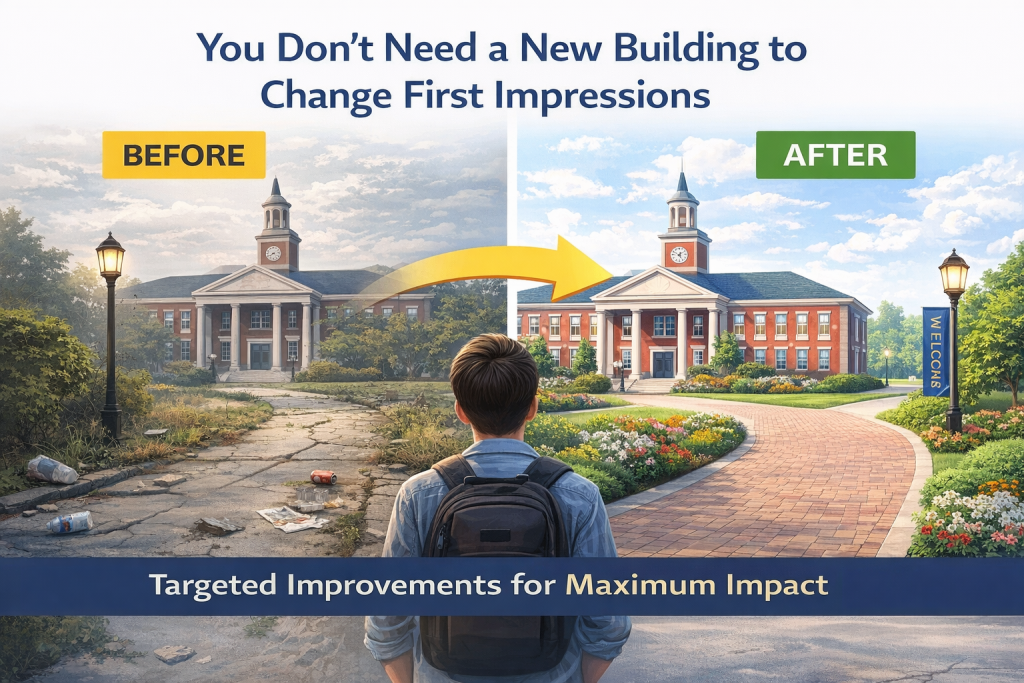
First impressions are shaped by what students see—not by how much was spent.
This paper explores how targeted, data-driven investments in high-visibility areas can significantly improve campus perception, support recruitment and retention, and strengthen institutional positioning—without the need for major construction projects.
The First Impression Reality
Campus visits remain one of the most influential moments in a student’s decision-making process.
Within minutes of arriving, prospective students and their families begin forming conclusions about:
- Institutional quality
- Financial stability
- Student experience
- Overall “fit”
These conclusions are not based on capital budgets or long-range plans.
They are based on what is immediately visible.
What Students Notice First
- Campus entry points and signage
- Walkways and accessibility
- Landscaping and site maintenance
- Building exteriors
- Residence hall conditions
- Lighting, cleanliness, and upkeep
These elements create a powerful, immediate narrative—often before a single word is spoken during a campus tour.
The Misconception: “We Need Something Big”
A common belief among institutional leadership is:
“We need a new building or major renovation to make an impact.”
This assumption leads to two challenges:
- Delayed Action
Institutions wait for large capital funding that may not materialize. - Missed Opportunities
Smaller, high-impact improvements are overlooked because they are perceived as less significant.
In reality, many of the most influential improvements are also among the most cost-effective.
The Power of Targeted Investment
Strategic institutions focus on high-visibility, high-impact improvements—areas that directly influence perception.
Examples of High-Impact, Targeted Improvements
1. Campus Entry and Arrival Experience
- Improved signage and wayfinding
- Landscaping enhancements
- Clean, well-defined pedestrian paths
2. Walkways and Site Infrastructure
- Repairing cracked or uneven surfaces
- Improving accessibility and safety
- Enhancing lighting for evening tours
3. Residence Hall Upgrades
- Fresh finishes (paint, flooring, lighting)
- Improved temperature control
- Addressing visible wear and tear
4. Exterior Building Maintenance
- Cleaning facades
- Repairing visible damage
- Addressing aging windows or doors
5. High-Traffic Academic Spaces
- Lighting upgrades
- Furniture improvements
- Minor modernization of finishes
These improvements are often modest in cost—but significant in perception.
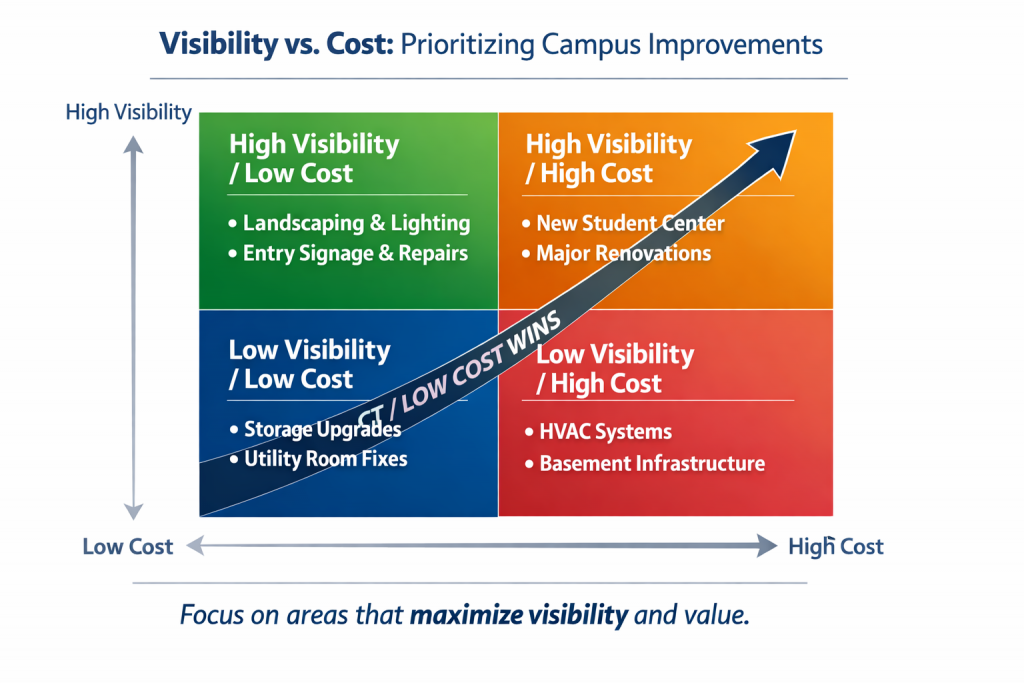
The “Visibility vs. Cost” Opportunity
One of the most effective frameworks for prioritization is evaluating projects based on:
- Visibility (What students see and experience)
- Cost (Investment required)
👉 Insert Graphic: Visibility vs. Cost Matrix
| Category | Example | Impact |
|---|---|---|
| High Visibility / Low Cost | Landscaping, lighting, cleaning | Immediate perception improvement |
| High Visibility / High Cost | New buildings | Long-term impact |
| Low Visibility / High Cost | Mechanical systems | Operational importance |
| Low Visibility / Low Cost | Back-of-house improvements | Minimal perception impact |
The goal is not to ignore critical infrastructure—but to ensure that limited capital is balanced between visibility and necessity.
The Risk of Neglecting Visible Conditions
Deferred maintenance in high-visibility areas carries unique risk:
1. Recruitment Impact
- Negative first impressions during campus visits
- Reduced emotional connection to campus
2. Retention Impact
- Students experience daily frustration with visible issues
- Perception of institutional neglect
3. Brand Perception
- Campus condition becomes associated with institutional quality
- Word-of-mouth and social media amplify impressions
4. Competitive Disadvantage
- Competing campuses may not be “better”—just better presented
Aligning Facilities with Enrollment Strategy
Facilities should not operate independently of enrollment goals.
Instead, institutions should ask:
- What spaces do prospective students see first?
- Where do tours spend the most time?
- Which areas most influence student life?
- What conditions create negative impressions?
By aligning capital planning with these questions, facilities become a strategic enrollment tool, not just an operational function.
The Role of Data in Identifying High-Impact Opportunities
While many improvements may seem obvious, relying solely on observation can lead to:
- Overlooking less visible but critical issues
- Misallocating resources
- Inconsistent decision-making
Data-driven facility assessments help identify:
- High-visibility deficiencies
- System conditions affecting user experience
- Opportunities for bundled improvements
- Cost-effective prioritization strategies
This ensures that investments are both strategic and defensible.
Case Scenario: Small Investment, Major Impact
Institution A: Reactive Approach
- Defers improvements due to limited capital
- Campus shows visible signs of wear
- Prospective students notice inconsistencies
- Enrollment softens over time
Institution B: Targeted Strategy
- Invests in landscaping, lighting, and key interiors
- Improves high-traffic areas first
- Enhances tour experience
- Strengthens perception without major capital spend
Result: Improved competitiveness with minimal capital investment.
How AmBIT Helps Institutions Maximize Impact
AmBIT works with institutions to identify where limited resources can create the greatest return.
Our approach includes:
- Facility condition assessments with visibility considerations
- Identification of high-impact, low-cost improvements
- Prioritized capital planning aligned with enrollment strategy
- Multi-year planning that balances infrastructure and perception
We help institutions answer a critical question:
“Where should we invest to make the biggest difference—right now?”
Conclusion
In today’s competitive environment, small and mid-sized colleges cannot rely solely on large capital projects to remain competitive.
They must be strategic.
They must be intentional.
And most importantly—they must recognize that:
Campus appearance is not cosmetic. It is strategic.
Targeted, data-driven improvements can transform perception, strengthen recruitment, and enhance the student experience—without requiring major construction.
Because ultimately:
It’s not how much you spend.
It’s where—and how—you spend it.

Written by
AmBIT Author